Our solar system’s famous “invader” might be as old as the Milky Way itself.
The unprecedented observations of comet 41P/Tuttle–Giacobini–Kresák show its rotation slowing, reversing and then speeding up, and jet-like outbursts of gas might be providing the push.
…
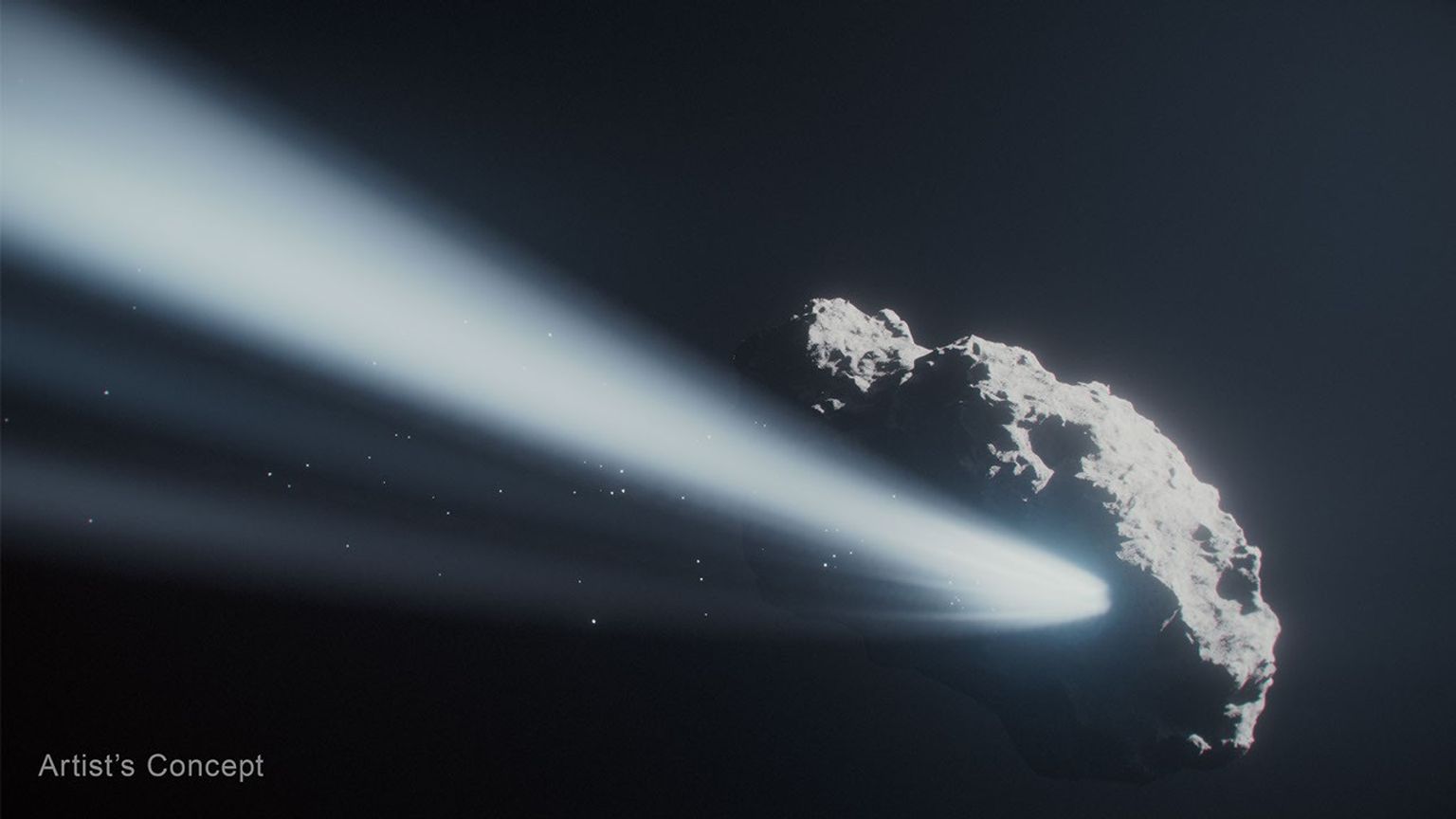
Astronomers using NASA’s Hubble Space Telescope have found evidence that the spinning of a small comet slowed and then reversed its direction of rotation, offering a dramatic example of how volatile activity can affect the spin and physical evolution of small bodies in the solar system. This is the first time researchers have observed evidence […]

The interstellar comet 3I/ATLAS will soon leave our solar system, never to return, but the observations of the comet will live on in NASA’s public data archives. More than a dozen NASA science missions turned their instruments to observe the comet, which is only the third identified object to be visiting our solar system from […]
NASA’s Hubble Space Telescope has captured a rare cosmic moment: a comet breaking apart in real time.

In a happy twist of fate, NASA’s Hubble Space Telescope just witnessed a comet in the act of breaking apart. The chance of that happening while Hubble watched is extraordinarily minuscule. The findings published Wednesday in the journal Icarus. The comet K1, whose full name is C/2025 K1 (ATLAS)—not to be confused with interstellar comet […]
The interstellar comet 3I/ATLAS is unusually rich in alcohol — a chemical clue that could reveal how planets and icy bodies form around other stars.
…
A newly discovered comet is rapidly brightening and could become visible from Earth — if it survives an extreme close encounter with the sun on April 4.
…
By taking advantage of a maneuver that would see a spacecraft fire rocket engines while in the solar corona, that spacecraft’s velocity could receive a huge boost — enough to allow it to catch up with 3I/ATLAS, which is th…
The fate of a comet that was predicted to pass close to Earth remains a mystery five years after its dramatic breakup in the inner solar system.
…