A critical vulnerability discovered across numerous HTTP/2 implementations has exposed a dangerous protocol-level vulnerability that enables threat actors to orchestrate potent denial-of-service (DoS) and distributed denial-of-service (DDoS) attacks. Tracked as CVE-2025-8671 and colloquially known as “MadeYouReset,” this vulnerability exploits a fundamental mismatch between the HTTP/2 specification and real-world server implementations. Security researchers from Tel Aviv […]
The emergence of AI-powered browsers represents a significant shift in how artificial intelligence interacts with web content. However, it has also introduced unprecedented challenges for digital publishers and content creators. Last week, OpenAI released Atlas, joining a growing wave of AI browsers including Perplexity’s Comet and Microsoft’s Copilot mode in Edge, that aim to transform […]
In the ever-evolving landscape of cyber threats, a new ransomware strain, Midnight, has emerged, echoing the notorious tactics of its predecessor, Babuk. First detected by Gen researchers, Midnight blends familiar ransomware mechanics with novel cryptographic modifications—some of which unintentionally open the door to file recovery. This represents a rare opportunity for victims to reclaim their […]
SonicWall, a global cybersecurity company, confirmed that state-sponsored hackers were behind a recent incident involving unauthorized access to firewall backup files.
The breach began in early September, when the company detected suspicious activity involving the download of backup firewall configuration files stored in a cloud environment.
Upon discovery, SonicWall quickly activated its incident response plan, called in Mandiant, a well-known cybersecurity response firm, and notified partners and customers directly.
The company maintained frequent and transparent communication, hosting live Q&A sessions and providing tools and guidance to help partners respond effectively.
SonicWall also offered commercial concessions to support partners as they worked through remediation steps.
Mandiant’s thorough investigation has now concluded. The results show that the attackers, linked to a state-sponsored threat group, used an API call to access cloud backup files stored in a specific cloud environment.
According to the findings, this incident did not relate to the recent global Akira ransomware attacks targeting firewalls and edge devices.
Importantly, SonicWall confirmed that its products, firmware, and other systems, like source code and customer networks, were not impacted or compromised.
All remediation actions recommended by Mandiant have been implemented, and SonicWall continues to work closely with security experts to strengthen its cloud and network infrastructure further.
The company emphasized that its long-standing focus on security excellence and partner support remains firm. Earlier in the year, SonicWall launched a Secure by Design modernization initiative.
This included updates to product architecture, cloud operations, internal cybersecurity practices, and the appointment of a new Chief Information Officer.
The company also continues to invest in advanced response teams and cutting-edge security tools. SonicWall’s determination to stay ahead is underscored by external validation.
Even as nation-state threat actors increasingly target security vendors, SonicWall is committed to transparency, strong partnerships, and relentless improvement to safeguard its customers and partners worldwide.
A critical remote code execution (RCE) flaw in three official extensions for Anthropic’s Claude Desktop. These vulnerabilities, affecting the Chrome, iMessage, and Apple Notes connectors, stem from unsanitized command injection and carry a high severity score of CVSS 8.9.
Published and promoted directly by Anthropic at the top of their extension marketplace, the flaws could allow attackers to execute arbitrary code on users’ machines through seemingly innocent interactions with the AI assistant. Fortunately, Anthropic has patched all three issues.
The discovery from KOI Security highlights the risks in emerging AI ecosystems, where extensions bridge powerful language models and local systems with minimal safeguards.
Unlike browser add-ons, these tools operate with full system privileges, amplifying the potential damage from basic security oversights.
Understanding Claude Desktop Extensions
Claude Desktop Extensions function as packaged MCP servers, distributed as .mcpb bundles, essentially zipped archives with server code and function manifests.
Extension Source: KOI
They offer a one-click installation similar to Chrome extensions but lack the sandboxing that protects browser environments. Instead, they run unsandboxed on the host machine, granting access to files, commands, credentials, and system settings.
This design positions them as privileged intermediaries between Claude’s AI and the operating system, making them potent but perilous.
The vulnerabilities exploited this trust. Each extension processed user inputs such as URLs or messages via AppleScript commands without proper sanitization.
For instance, a command to open a URL in Chrome used template literals to insert the input directly, like: tell application “Google Chrome” to open location.
An attacker could craft a malicious input to escape the string context and inject arbitrary AppleScript, which then triggers shell commands with elevated privileges.
A simple exploit payload escapes the quotes and executes remote code. This classic command injection flaw, one of the oldest in software security, underscores how fundamental errors can persist in production code.
Attack Chain (Source : KOI)
The real danger lies not in users typing malicious commands but in prompt injection via web content. Claude Desktop routinely fetches and analyzes web pages to answer questions, creating an unwitting attack vector, KOI security added.
An attacker controlling a search result page could detect Claude’s user agent and serve tailored malicious content.
The AI, interpreting this as helpful instructions, triggers the vulnerable Chrome extension. The injected code runs silently, potentially stealing SSH keys, AWS credentials, browser passwords, or even installing backdoors all without user suspicion.
This chain, from web content to AI processing to local execution, effectively grants remote attackers shell access. No malware downloads or phishing are needed; a normal AI query suffices.
These flaws in Anthropic’s own extensions raise concerns about the maturity of the MCP ecosystem. As independent developers flood the marketplace with AI-assisted code under limited review, the risks of full-privilege extensions could escalate.
Users must treat these tools as high-risk executables, not casual plugins, and prioritize updates.
Anthropic’s swift fixes mitigate immediate threats, but the incident calls for robust security practices across AI platforms. At Koi, ongoing research aims to spot such issues early, safeguarding users in this rapidly evolving landscape.
Proofpoint Threat Research has identified a previously unknown Iranian threat actor, dubbed UNK_SmudgedSerpent, that conducted sophisticated phishing campaigns against academics and foreign policy experts between June and August 2025. The group employed credential harvesting techniques, sophisticated social engineering, and remote management tools to infiltrate targets, revealing a complex web of overlapping tactics reminiscent of established […]
Cisco has issued a critical warning about ongoing attacks targeting a severe remote code execution vulnerability affecting its Secure Firewall, Adaptive Security Appliance, and Threat Defense Software. The company updated its security advisory on November 5, 2025, revealing that threat actors have discovered a new attack variant capable of fully compromising devices on unpatched systems. […]
Security researchers have uncovered a sophisticated attack campaign attributed to Kimsuky, the North Korean-backed threat group known for conducting espionage operations against government entities and think tanks. Recent analysis reveals that threat actors are leveraging Visual Studio Code extensions and GitHub as command-and-control infrastructure to deliver multi-stage malware payloads capable of deploying ransomware and conducting […]
In the early hours of November 3, 2025, Check Point Research’s blockchain threat monitoring systems flagged a suspicious pattern on the Ethereum mainnet. The alert stemmed from Balancer V2’s Vault contract, which soon revealed one of the most devastating DeFi vulnerabilities to date. Before defenders could intervene, attackers had siphoned $128.64 million from Balancer ComposableStablePool […]
On November 3, 2025, blockchain security monitoring systems detected a sophisticated exploit targeting Balancer V2’s ComposableStablePool contracts.
An attacker executed a precision loss vulnerability to drain $128.64 million across six blockchain networks in under 30 minutes.
The attack leveraged a rounding error in the _upscaleArray function combined with carefully crafted batchSwap operations, allowing the attacker to artificially suppress BPT (Balancer Pool Token) prices and extract value through repeated arbitrage cycles.
The exploitation occurred primarily during smart contract deployment, with the attacker’s constructor executing over 65 micro-swaps that compounded precision loss to devastating effect.
This incident represents a watershed moment for DeFi security, demonstrating how mathematical vulnerabilities in core protocol functions can be weaponized through automation and precise parameter tuning.
The attack’s sophistication lay not in exploiting a novel vulnerability type, but in recognizing how negligible rounding errors become catastrophic when amplified through dozens of operations in atomic transactions.
Check Point researchers noted that the attack exploited a fundamental weakness in how Balancer’s ComposableStablePools handle small-value swaps.
The attack exploited a mathematical vulnerability in how Balancer’s ComposableStablePools handle small-value swaps (Source – Check Point)
When token balances are pushed to specific rounding boundaries, particularly the 8-9 wei range, Solidity’s integer division causes significant precision loss.
The researchers identified that individual swaps produce negligible errors, but within a single batchSwap transaction containing 65 operations, these losses compound dramatically, creating exploitable arbitrage opportunities.
The attacker’s technical execution revealed a three-stage pattern repeated 65 times atomically. First, large BPT amounts were swapped for underlying tokens to push specific token balances to critical rounding boundaries.
Second, small swaps involving boundary-positioned tokens triggered precision loss through the _upscaleArray function’s mulDown operation, causing the invariant D (representing total pool value) to be underestimated and BPT price to drop artificially.
Third, the attacker purchased BPT at suppressed prices and immediately redeemed for underlying assets at full value, capturing the price discrepancy as profit.
The Exploit Contract Architecture and Technical Breakdown
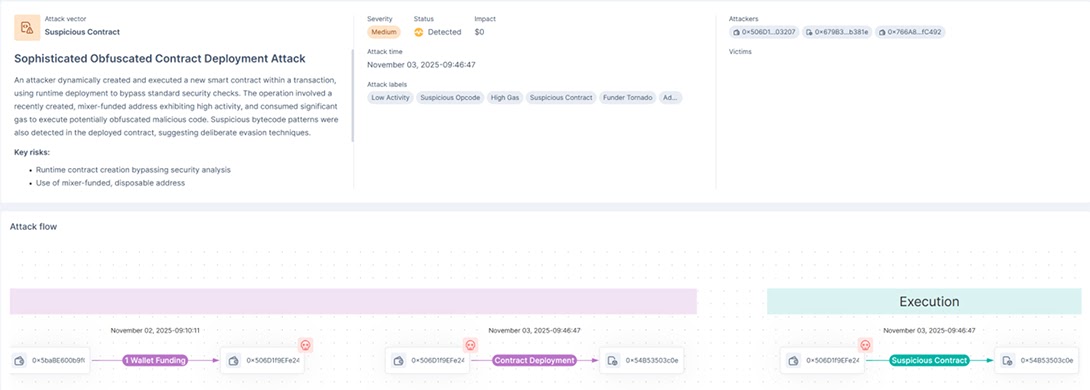
Check Point analysts identified the exploit contract deployed at address 0x54B53503c0e2173Df29f8da735fBd45Ee8aBa30d operating with a sophisticated three-address structure designed for operational separation and fund management.
The vulnerability stemmed from the _upscaleArray function’s implementation, which performs integer division during balance scaling operations.
The mulDown function creates rounding errors that propagate directly to invariant calculations, ultimately determining BPT pricing.
The attacker’s constructor automatically executed the complete exploitation sequence targeting two Balancer pools simultaneously.
Analysis revealed 65 token transfers to Balancer’s Protocol Fees Collector, displaying characteristic patterns of iterative precision exploitation.
The stolen value accumulated in the contract’s internal balance through InternalBalanceChanged events: Pool 1 generated +4,623 WETH and +6,851 osETH, while Pool 2 contributed +1,963 WETH and +4,259 wstETH.
Following the initial theft, a secondary withdrawal function transferred the accumulated 6,586 WETH plus additional assets to the final recipient address.
This two-stage approach separated theft execution from fund extraction, demonstrating operational discipline and reducing detection surface during the critical exploitation window.
Follow us on Google News, LinkedIn, and X to Get More Instant Updates, Set CSN as a Preferred Source in Google.


.webp)