• HUNTSVILLE, Ala.—There are less than four months left in the year, but defense and aerospace company Arcfield’s plans seem to just be getting started, as they prepare for an upcoming satellite launch and explore manufacturing a highly specialized component key for optical sensors and laser communications.

    “There's a lot going on at Arcfield. And what we're really focused on is bringing the government a fully-baked solution,” Dan Knight, Arcfield’s vice president for Golden Dome initiatives and strategy, told Defense One at the Space and Missile Defense Symposium in Huntsville, Ala., last week. “Instead of saying, ‘Hey, I'm the one-trick wonder that just does sensors,’ or ‘I'm the one-trick wonder that just does architecture,’ we leverage all of our expertise across our organization to bring something that can be easily integrated and operationalized.”

    Arcfield is planning to test several sensors in the coming months, and its subsidiary, Orion Space Solutions, expects to launch a very low earth orbit, or VLEO, satellite in September. 

    “You launch it up to the International Space Station. One of the astronauts up there takes it out, puts it in like a little Pez dispenser, and drops it down into very low Earth orbit,” Knight said. “There's a lot of sensing that happens in the ionosphere with this particular satellite—and some communications packages and other things.”

    Knight said the company is forging geostationary orbit satellite plans for 2027 on top of supporting Golden Dome with mission engineering.

    “We have a long history of [low-Earth orbit] satellites. We're building a GEO refueler so that the Space Force can maneuver without regret…and then we do optical and [high frequency] sensors,” Knight said, speaking about missile warning and tracking.

    The company also wants to scale its manufacturing ability for a very special type of glass. 

    “We want to get into the manufacturing business of something called an etalon. And you're like, I've never heard the word etalon in my life!” Knight said with a laugh. “It's a highly polished piece of glass. And it's needed for a variety of optical applications—so laser communications, very precise telescopes, and very, very sophisticated optical sensors like the ones we build.”

    The move comes as the U.S. military increasingly relies on sensors to garner intel, improve navigation, and fuel autonomy, all while the White House pushes for domestic manufacturing of national security technologies.  

    “There's a backlog based on our foreign suppliers. We really want to get that investment from the government, which is what they've said they want to do, and get that online so that we can provide etalons for the defense industrial base,” Knight said, referring to working with the Pentagon’s Manufacturing Technology, or ManTech, program. 

    Arcfield already makes etalons for its products but expansion would support internal growth and the industrial base overall, Knight said. The company has conducted demos and submitted a white paper to start the process with hopes of getting government funding to help build out its manufacturing capacity for a larger scale.

    “We want to expand our manufacturing line for our optical sensor…and within that, that's going to require a fairly significant expansion of the etalon production. We can't [rely] on a company in Canada that produces it,” he said.

    Welcome

    You’ve reached the Defense Business Brief, where we dig into what the Pentagon buys, who they’re buying from, and why. Send along your tips, feedback, and song recommendations to lwilliams@defenseone.com. Check out the Defense Business Brief archive here, and tell your friends to subscribe!

    A space-age name change. The German air force, Luftwaffe, officially changed its English name translation to the German Air and Space Force, said Maj. Gen. Michael Traut, who leads Germany’s Space Command. 

    • “What we've seen is that the air and the space domains [are] increasingly merging,” Traut said during an international space panel at the Space and Missile Defense Symposium last week. 
    • Germany wants to procure space surveillance radars, he said, adding that, “Of course, we know that capable missile defense radars can look into space as well. As such, I'm completely interested in the data they provide, and I'm completely interested in the integration.”
    • Last year, Germany committed €35 billion to space-related defense projects. The NATO nation is also interested in hypersonic vehicles, specifically space planes, presenting “an opportunity to operate in different altitudes we were used to,” Traut said. 
    • “We are absolutely committed strategically to develop and operate space planes in high atmospheric hypersonic operations. [That] not only sets us up to defend against enemy threats, but to explore and make use of that altitude as well.”

    Increased munitions options means launchers should do more with less. Common Autonomous Multi-Domain Launcher, or CAML, represents the kind of thinking we need around launchers, Brig. Gen. Robert J. Mikesh, the Army’s capability program executive for offensive fires, said during the symposium. 

    • “We should not think of every launcher as permanently married to a single missile or munition,” Mikesh said. 
    • “We need to think about adaptable platforms, commonality, autonomy, payloads for both offensive or defensive environments, reduced soldier burden and the ability to integrate new capabilities more rapidly. The launcher can no longer be an afterthought,” Mikesh said.

    Bonus round: NORTHCOM keeps eye on security needs for power generation and increasingly electrified military systems and command and control centers, said Lt. Gen. Joseph Jarrard, the command’s deputy commander. 

    • “We are aware of some of the issues with respect to that,” Jarrard said during the Q&A portion of his keynote at the symposium. “Obviously some of our critical infrastructure requires some of those energy sources. And so I will say that's on our radar…But it hasn't necessarily risen to the level we consider it to be a problem that we have to deal with directly, right now.”
    • One thing that is top of mind: The lack of sensors to spot and protect military bases from drone attacks. 

    Making moves + other news

    • The Missile Defense Agency awarded X-Bow Systems an $11 million contract for testing and development of low-cost interceptors.
    • Rocketmaker United Launch Alliance names Mark Peller as CEO.
    • Sam Mehta takes over as L3Harris’ CEO, following the ousting of Chris Kubasik.
    • Auriga Space brings on former MDA Director Trey Obering as an advisor, Defense One has learned.
    • REGENT’s seaglider drone platform performs in the Silent Swarm defense event.
    • CACI opens a manufacturing center in Rochester, N.Y. 
    • Havoc AI teams up with Red Cat. 
    • The Pentagon is auditing academic institutions to scrutinize foreign ties. Related: Reuters looks at how U.S. military funding fueled China’s robot dog boo

    ]]>

    ¶¶¶¶¶

    ¶¶¶¶¶

    ¶¶¶¶¶

    ¶¶¶¶¶

    ¶¶¶¶¶

  • Cybersecurity researchers have disclosed details of a remote Spectre attack against Cloudflare Workers that leaked a JSON Web Token (JWT) from a co-located Worker in the production environment at up to 12 bits per second, 360 times the rate of an earlier attack demonstrated in 2021. The end-to-end experiment used an attacker Worker and a victim Worker controlled by the researchers,

    ¶¶¶¶¶

    ¶¶¶¶¶

    ¶¶¶¶¶

    ¶¶¶¶¶

    ¶¶¶¶¶

  • IAM Locks the Door. ITDR Catches the Intruders?

    – Christophe Briguet, Sr. Director of Product Management – AI & Security Analytics, Stellar Cyber

    San Jose, Calif. – Aug. 19, 2026

    Your employee successfully authenticates.

    The account is valid. The permissions are legitimate.

    There’s just one problem:

    The person using the identity may be an attacker.

    That scenario gets to the heart of one of the biggest changes happening in enterprise security. For years, organizations have invested heavily in Identity and Access Management (IAM) to answer an essential question:

    Who should have access to what?

    Today, IT and security leaders need to answer another question just as quickly:

    What is that identity doing right now?

    That’s the problem Identity Threat Detection and Response (ITDR) is designed to solve.

    The identity problem has changed

    IAM isn’t becoming less important. Quite the opposite.

    Gartner says human and machine identities have emerged as the primary attack surface, while increasing complexity and isolated IAM tools create visibility gaps.

    But preventing unauthorized access is only one part of the problem.

    Gartner’s March 2026 Implement ITDR Practice to Combat Identity-Based Attacks puts the distinction clearly: traditional IAM solutions are essential, but they are primarily preventative controls and are not designed to address attacks that leverage existing human or machine identities.

    In other words:

    IAM determines whether an identity should be trusted. ITDR determines whether that trusted identity is behaving like an attacker.

    That’s a critical distinction when legitimate credentials themselves have become an attack path.

    According to the Gartner ITDR report, credential misuse was the leading cause of security breaches cited from the 2025 Verizon DBIR. Gartner’s own machine identity research also found that more than 50% of surveyed organizations had experienced one or more cybersecurity incidents involving compromised machine identities.

    And the window defenders have to react could get smaller.

    Gartner predicts that by 2027, AI agents will automate credential theft and compromise authentication communication channels, reducing exploitation time for exposed accounts by 50%.

    That’s why identity security increasingly needs to operate in the now.

    Prevention before the attack. Detection while it’s happening.

    This is not an IAM-versus-ITDR argument.

    Organizations need both.

    IAM establishes identity hygiene, access policies, authentication and privileges. ITDR provides another layer when those preventive controls are bypassed or abused.

    Gartner describes ITDR as the second and third layers of identity defense: detection and response after prevention. Its research distinguishes preattack identity hygiene from monitoring and stopping active attacks using real-time threat intelligence.

    That changes the questions the SOC can ask.

    Is this user logging in from somewhere unexpected?

    Has this service account suddenly changed behavior?

    Is a privileged identity accessing systems it normally doesn’t?

    Is this identity moving laterally?

    Does apparently legitimate identity activity correlate with suspicious endpoint, network or cloud behavior?

    The goal isn’t simply more identity alerts.

    The outcome is reducing the time between identity compromise, understanding what’s happening and taking action.

    Identity can’t become another security silo

    There’s another important consideration for IT and security leaders.

    An identity attack rarely stays inside the identity system.

    An attacker may compromise an account, authenticate successfully, access a cloud application, move across the network and ultimately interact with an endpoint or sensitive data.

    That means identity context needs to reach the SOC.

    Gartner specifically recommends integrating IAM-originated incidents into SOC response and threat-hunting processes.

    And there’s a measurable reason to bring those teams together. Gartner’s 2024 IAM Leadership Survey found that collaboration between IAM and cybersecurity functions across controls, risk assessment and threat management led to a 30% improvement in achieving IAM goals.

    This is where Stellar Cyber takes a different approach to ITDR.

    Rather than creating another identity security console for analysts to monitor, ITDR is built into the Stellar Cyber SecOps Platform. Identity telemetry from technologies such as Active Directory, Microsoft Entra ID and Okta can be correlated with endpoint, network, cloud and other security signals.

    The objective is straightforward:

    See the identity as part of the attack, not as an isolated event.

    From identity anomaly to action

    Stellar Cyber 6.6 pushes that approach further.

    The release improves login-anomaly fidelity for detections including Impossible Travel and User Login Location anomalies, adding customizable suppression, better username prioritization and ASN enrichment for Impossible Travel detections.

    And this isn’t simply historical analysis.

    For on-time data, Stellar Cyber documents an expected detection delay of 5–10 minutes after ingestion for Impossible Travel anomalies, although ingestion delays can extend that window.

    Once suspicious identity behavior is identified, response matters just as much. With Microsoft Entra ID, for example, Stellar Cyber can enrich events with identity information and support actions including disabling a user, confirming compromise and revoking sign-in sessions.

    That creates the operational progression ITDR should deliver:

    Detect suspicious identity behavior.
    Understand it in the context of the broader attack.
    Prioritize the risk.
    Respond before the attacker can do more damage.

    Trust is no longer a one-time decision

    IAM remains essential.

    Strong authentication remains essential. MFA remains essential. Privilege management and identity hygiene remain essential.

    But successful authentication cannot be the end of the security decision.

    Gartner predicts that by 2028, 70% of CISOs will use identity visibility and intelligence capabilities to shrink the IAM attack surface and reduce credential-compromise risk.

    The shift is from asking only:

    “Should this identity have access?”

    to continuously asking:

    “What is this identity doing now—and should we trust it?”

    Because attackers don’t care that your IAM controls worked.

    They care whether they can become someone your organization already trusts.

    IAM protects the identity. ITDR protects the moment.

    References

    1. Gartner, 2026 Predicts: Identity and Access Management, Paul Mezzera, Rebecca Archambault, James Hoover and Shubham Gera, 22 January 2026, ID G00841403.
    2. Gartner, Implement ITDR Practice to Combat Identity-Based Attacks, James Hoover, Peter Firstbrook and Rebecca Archambault, 5 March 2026, ID G00845676.

    Christophe Briguet, Sr. Director of Product Management – AI & Security Analytics, Stellar Cyber


    About Stellar Cyber

    Stellar Cyber’s Open XDR Platform delivers comprehensive, unified security without complexity, empowering lean security teams of any skill level to secure their environments successfully. With Stellar Cyber, organizations reduce risk with early and precise identification and remediation of threats while slashing costs, retaining investments in existing tools, and improving analyst productivity, delivering an 8X improvement in MTTD and a 20X improvement in MTTR. The company is based in Silicon Valley. For more information, visit https://stellarcyber.ai.

    The post IAM Protects the Identity. ITDR Protects the Moment. appeared first on Cybercrime Magazine.

    ¶¶¶¶¶

    ¶¶¶¶¶

    ¶¶¶¶¶

    ¶¶¶¶¶

    ¶¶¶¶¶

  • OpenAI on Tuesday revealed that it paused reinforcement learning (RL) training for its latest artificial intelligence (AI) models for two weeks while it shored up additional defenses and increased the scope of its monitoring to avert another Hugging Face-like incident. “As models become more capable, the risks associated with developing and testing them internally also grow,” the AI company

    ¶¶¶¶¶

    ¶¶¶¶¶

    ¶¶¶¶¶

    ¶¶¶¶¶

    ¶¶¶¶¶

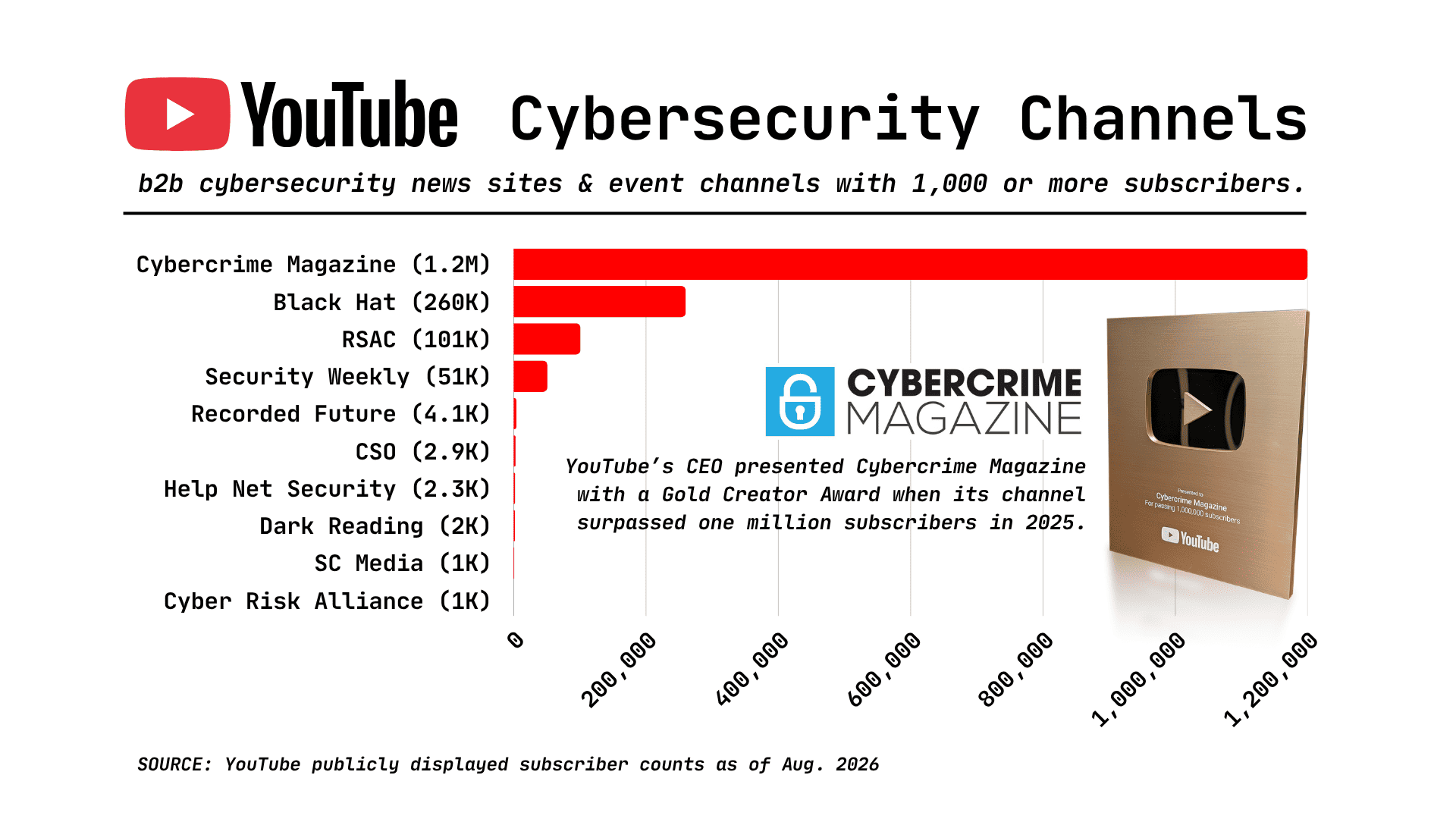
  • The top b2b focused cybersecurity media and event channels listed by number of subscribers and views per video

    – Steve Morgan, Editor-in-Chief

    Sausalito, Calif. – Aug. 19, 2026

    As one of the world’s largest social media platforms with more than 2.7 billion monthly users, YouTube can help brands reach their audience at scale. But the platform offers more than visibility; it’s become one of the primary ways customers discover products and make purchasing decisions, according to Salesforce. This means it gives brands the chance to engage at every stage of the sales funnel. As such, YouTube marketing is now a must-have for brands that want to get discovered, build trust, and drive demand at scale.

    YouTube is a powerhouse for marketing because of its vast user base, high engagement rates with video content, and ability to boost brand awareness, drive traffic, and build trust through educational and engaging content, all while leveraging the power of Google’s search engine.

    YouTube also functions as the world’s second-largest search engine (behind its parent). It allows businesses to build long-term trust, educate buyers, and capture high-intent prospects who are actively searching for product solutions. Video content also compounds in value over time, unlike fleeting social media posts.

    “I want to watch the (Cybercrime Magazine YouTube Channel) CISO Demo series because it gives me lots of information about a specific vendor or capability or even risk that I’m trying to address in a single byte-size amount of time,” says Adam Keown, CISO at Fortune 500 company Eastman. “That helps me narrow down two or three vendors to talk to versus having to speak to the tens-of-thousands of cybersecurity vendors that are out there.”

    Video builds immediate familiarity by letting audiences see faces, hear voices, and experience corporate culture. B2B offerings — such as cybersecurity software and solutions  — are much easier to demonstrate using deep-dive b-roll and product walkthroughs.

    AI models (like Gemini and ChatGPT) frequently cite and pull context from YouTube transcripts and metadata, making video an essential part of modern Generative Engine Optimization (GEO).

    TOP B2B FOCUSED CYBERSECURITY CHANNELS

    Out of the pure play cybersecurity b2b focused media outlets and event producers with YouTube channels listed by their number of subscribers (minimum of 1,000 subscribers), Cybercrime Magazine is far and away the top channel based on its number of subscribers (1.2 million), and views per video.


    The editors at Cybercrime Magazine compiled the list by searching on all cybersecurity focused media outlets (b2b media / news sites and event producers) that they are aware of, and then looking up their channel for the publicly displayed subscriber counts reported by YouTube.

    – Steve Morgan is founder and Editor-in-Chief at Cybersecurity Ventures.

    Go here to read all of my blogs and articles covering cybersecurity. Go here to send me story tips, feedback and suggestions.

    The post YouTube Is The New Powerhouse For Marketing To CISOs And MSSPs appeared first on Cybercrime Magazine.

    ¶¶¶¶¶

    ¶¶¶¶¶

    ¶¶¶¶¶

    ¶¶¶¶¶

    ¶¶¶¶¶

  • Federal prosecutors have charged 17 Iranians affiliated with the Tehran-based Mabna Institute over an alleged hacking-for-hire operation that stole research and intellectual property from hundreds of universities and compromised email accounts belonging to U.S. government agencies and companies.

    The 14-count superseding indictment, unsealed Tuesday, adds eight defendants to a case brought against nine other members of the firm in 2018. Prosecutors said the expanded charges expose a broader network that conducted cyber intrusions for Iran’s Islamic Revolutionary Guard Corps and other Iranian government and university clients.

    The Mabna Institute targeted systems belonging to 144 U.S. universities, 178 universities abroad, at least 42 U.S. companies, 11 foreign companies and at least five federal and state government agencies since around 2013, according to the Justice Department.

    The victims included the Labor Department, Federal Energy Regulatory Commission, the states of Hawaii and Indiana, the United Nations and UNICEF. The hackers also allegedly targeted HBO and unnamed technology firms and defense contractors.

    Prosecutors said the university campaign targeted more than 100,000 professors’ accounts worldwide and successfully compromised approximately 8,000. The hackers used stolen credentials to access journals, dissertations, electronic books and other research spanning fields ranging from medicine and engineering to the social sciences.

    All told, the group allegedly stole at least 31.5 terabytes of academic data and intellectual property. U.S. universities had spent more than $3.4 billion to procure or obtain access to the targeted materials, although prosecutors did not characterize that entire amount as a financial loss from the theft.

    Some of the stolen material was later sold to customers in Iran through two websites. One offered academic resources taken from universities, while the other allowed customers to use compromised professors’ accounts to enter university library systems directly, according to the indictment.

    Prosecutors said Mabna’s founders established the firm to help Iranian universities and research organizations obtain scientific resources from abroad. It employed or contracted with hackers who carried out phishing attacks, searched for vulnerable systems and traded credentials for compromised accounts.

    The defendants face charges that include conspiracy to commit computer intrusions, wire fraud and aggravated identity theft. Some of the offenses carry maximum prison sentences of 20 years. The State Department is separately offering a reward of up to $10 million for information leading to the location of five of the defendants.

    The charges come amid concerns about Iran’s use of cyber operations during the ongoing war.

    Since U.S. and Israeli strikes began in February, suspected Iran-aligned groups have been linked to a disruptive attack against medical technology company Stryker, the compromise of FBI Director Kash Patel’s personal email and attacks against industrial-control systems across several U.S. sectors.

    More than 30 Minnesota water systems and water infrastructure in several other states have been targeted in the last month in activity some officials suspect may be tied to Iran. U.S. officials previously told Nextgov/FCW that they expected Iranian and Iran-aligned cyber operations to continue regardless of whether fighting subsided.

    ]]>

    ¶¶¶¶¶

    ¶¶¶¶¶

    ¶¶¶¶¶

    ¶¶¶¶¶

    ¶¶¶¶¶

  • New York, New York, August 19th, 2026, CyberNewswire New revenue leader and board member join as AppViewX’s identity security business continues its rapid growth  AppViewX, the leading machine and agent identity security company built for the AI and quantum enterprise, today announced the appointment of Mike Durso as Chief Revenue Officer and the addition of […]

    The post Former Ping Identity and CyberArk Executives Join AppViewX to Scale Machine and Agent Identity Security appeared first on GBHackers Security | #1 Globally Trusted Cyber Security News Platform.

    ¶¶¶¶¶

    ¶¶¶¶¶

    ¶¶¶¶¶

    ¶¶¶¶¶

    ¶¶¶¶¶

  • A China-nexus threat actor is targeting Myanmar government and diplomatic personnel with a multi-stage malware campaign that delivers a custom Go-based backdoor, dubbed QUICAgent, through Virtual Hard Disk (VHD) files disguised as benign images. The campaign relies on highly targeted social engineering. One malicious file, named TrainingAnnouncement.jpg, is not an image but a VHD container. […]

    The post China-Nexus Hackers Target Myanmar Diplomats With QUICAgent Go Backdoor via Malicious VHD Files appeared first on GBHackers Security | #1 Globally Trusted Cyber Security News Platform.

    ¶¶¶¶¶

    ¶¶¶¶¶

    ¶¶¶¶¶

    ¶¶¶¶¶

    ¶¶¶¶¶

  • A previously unreported cyber espionage operation dubbed SilkParasite has been observed targeting government bodies in Central Asia. The intrusion set makes use of seven remote access tool (RAT) families, five of which have never been previously documented: DriveSilkRAT, CookiETagRAT, NomadRAT, GoginRAT, and NodeEdgeRAT. SilkParasite, first discovered in late 2025, is assessed to be a

    ¶¶¶¶¶

    ¶¶¶¶¶

    ¶¶¶¶¶

    ¶¶¶¶¶

    ¶¶¶¶¶

  • This week in cybersecurity from the editors at Cybercrime Magazine

    Sausalito, Calif. – Aug. 19, 2026

    – Watch the Video

    Binary Defense, a trusted Managed Detection and Response (MDR) and enterprise defense provider, earlier this year announced the launch of NightBeacon, an AI-powered security operations platform built directly into the company’s security operations center (SOC).

    “NightBeacon AI is my brainchild, developed alongside our team not to chase the AI hype cycle, but to solve a problem this industry has struggled with for years,” said David Kennedy, Founder and CEO of Binary Defense.

    “Security operations teams are drowning in data and noise, and NightBeacon was engineered from the ground up to change that,” added Kennedy. “This isn’t another AI feature bolted onto an existing product – it’s a system designed by practitioners for practitioners. It’s something our analysts rely on every day, and it represents what a truly AI-enabled SOC should look like.”

    Cybercrime Magazine met with Kennedy at Black Hat USA 2026 for a NightBeacon elevator pitch. It appears to be just what the CISOs and MSSPs have ordered.

    Watch the Video


    Cybercrime Magazine is Page ONE for Cybersecurity. Go to any of our sections to read the latest:

    • SCAM. The latest schemes, frauds, and social engineering attacks being launched on consumers globally.
    • NEWS. Breaking coverage on cyberattacks and data breaches, and the most recent privacy and security stories.
    • HACK. Another organization gets hacked every day. We tell you who, what, where, when, and why.
    • VC. Cybersecurity venture capital deal flow with the latest investment activity from various sources around the world.
    • M&A. Cybersecurity mergers and acquisitions including big tech, pure cyber, product vendors and professional services.
    • BLOG. What’s happening at Cybercrime Magazine. Plus the stories that don’t make headlines (but maybe they should).
    • PRESS. Cybersecurity industry news and press releases in real time from the editors at Business Wire.
    • PODCAST. New episodes daily on the Cybercrime Magazine Podcast feature victims, law enforcement, vendors, and cybersecurity experts.
    • RADIO. Tune into WCYB Digital Radio at Cybercrime.Radio, the first and only round-the-clock internet radio station devoted to cybersecurity.

    Contact us to send story tips, feedback and suggestions, and for sponsorship opportunities and custom media productions.

    The post Binary Defense Launches NightBeacon, An AI-Driven SOC Platform Built For The Speed Of Modern Cyberattacks appeared first on Cybercrime Magazine.

    ¶¶¶¶¶

    ¶¶¶¶¶

    ¶¶¶¶¶

    ¶¶¶¶¶

    ¶¶¶¶¶