Googlebook sounds like an ambitious new laptop category built around Gemini Intelligence, but its most convincing ideas may be the Magic Pointer and native Android app access.
A ransomware group has claimed responsibility for hacking the electronics manufacturing giant Foxconn, and is attempting to extort the company.

Google announced its new Googlebook laptop platform yesterday, and so far I’ve been left asking, “Why?” Why is Google blowing up its Chromebook and ChromeOS platform for this? I’ve been excited by the prospect of Android and ChromeOS unifying under the long-rumored Aluminium OS. The theory was that Aluminium might unite Android and ChromeOS under […]
Google says some Chromebooks will transition into the new Googlebook experience, but it hasn’t named eligible models yet. Current ChromeOS support continues, making the next upgrade decision less urgent but more complicated.
Google confirmed Googlebook laptops will support chips from Intel, Qualcomm, and MediaTek. That means real hardware variety from day one, and a lot more flexibility for buyers across different needs and budgets.
Google stepped into The Android Show with a laptop nobody saw coming, an AI layer that does your errands, and a security overhaul that’s long overdue.
Google is giving the mouse pointer a Gemini-powered upgrade on Googlebook, allowing users to point, speak, and get help across the desktop without writing detailed prompts.
Artificial intelligence platforms may be just as susceptible to social engineering as human beings, but they are proving remarkably good at finding security vulnerabilities in human-made computer code. That reality is on full display this month with some of the more widely-used software makers — including Apple, Google, Microsoft, Mozilla and Oracle — fixing near record volumes of security bugs, and/or quickening the tempo of their patch releases.
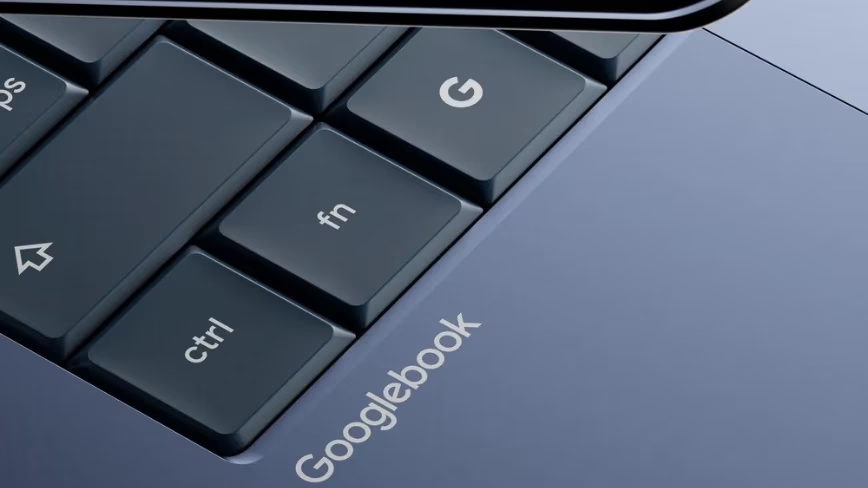
Google killed the Chromebook. It took 15 years, but the company that invented the browser-as-operating-system has concluded that a browser is not enough. At the Android Show on Monday, Google unveiled Googlebook, a new category of premium laptops run…

Google has identified the first zero-day exploit it believes was developed with artificial intelligence. The criminal threat actor that built it planned to use it in a mass exploitation event. Google’s Threat Intelligence Group discovered the vulnera…